Five classic puzzle games and the one idea behind each
Solitaire, tile pairs, nonograms, parking jams and word search: where each classic came from, the one idea behind it, and how to play it well.
Some puzzles are invented, enjoyed for a season and forgotten. Others survive every change of format, from paper to cardboard to pocket consoles to phones, and still feel new. Five of the longest-lived are patience card games, tile pairing, picture logic grids, sliding parking jams and word searches. Each rests on one simple idea, and once you can name that idea you play the game noticeably better.
Patience: order hidden under disorder
Card solitaire, also called patience, grew up in the parlors of the nineteenth century, and the version most people know is Klondike: seven columns, cards stacked face down, and four foundations to build from ace to king. The idea underneath is that the deck is already ordered; you simply cannot see most of it. Every face-down card is a locked door, and the whole game is about choosing which door to open next.
That idea gives the best single tip for Klondike. When two moves look equal, pick the one that turns over a face-down card, and prefer the column with the most hidden cards, because that is where the trouble is buried. FreeCell flips the idea around: every card is dealt face up, so nothing is hidden, and nearly every deal can be won with careful planning. Spider asks you to build full suits inside the columns themselves. Our Solitaire has all three, with every Klondike level checked by a solver before you see it.
Tile pairs: the order you remove things in
Tile pairing games use the pretty tiles from the old Chinese game of mahjong, but the solitaire version is a much later invention, popular on early home computers in the 1980s. Tiles are piled into a layered shape, and you remove matching pairs whenever both tiles are free: nothing on top, and an open side on the left or the right.
The idea here is that the order of removal matters more than finding matches. A careless player clears the easy pairs on the surface and later discovers that the last two of a kind are stacked on top of each other, which makes the board impossible. Two habits prevent that. First, when you can see all four of a kind, clear them as two pairs right away. Second, when you have a choice, take the pair that uncovers the most tiles or opens the longest row. In Mahjong every layout is built backward from a winning order, so a clean clear always exists.
Picture logic: counting into a picture
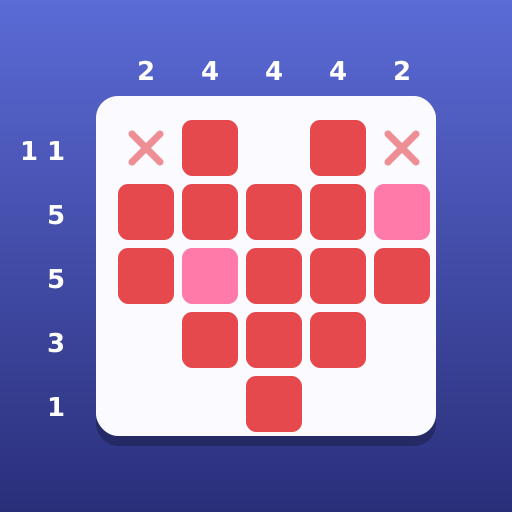
Picture logic grids, also called nonograms or griddlers, appeared in Japanese puzzle magazines in the late 1980s and spread quickly to newspapers around the world. Each row and column carries a list of numbers, and each number is a run of filled squares. Solve every line and a small pixel picture appears.
The idea is overlap. If a ten-square row has a single clue of 7, the run could start anywhere from the first square to the fourth, but in every one of those positions it covers squares four to seven. Those four squares are certain before you know anything else. Large clues and lines whose clues nearly fill the width are where every good solve begins. After that it is a back-and-forth conversation: each square you fill in a row tells the crossing column something new. Our Nonogram game keeps every puzzle solvable this way, one line at a time, with no guessing.
Parking jams: thinking backward
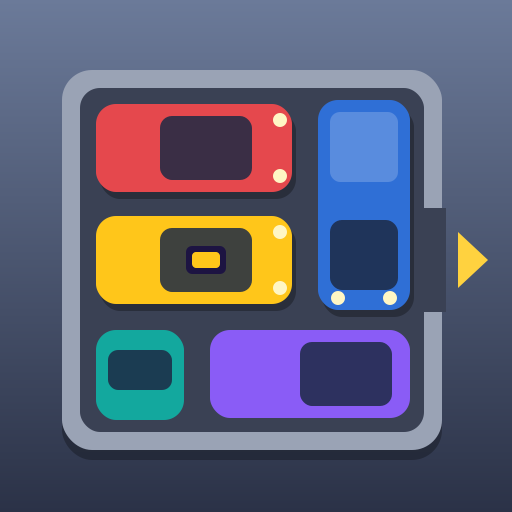
Sliding block puzzles where vehicles move only along their own length became famous as boxed tabletop games in the 1990s. A six by six lot holds cars and longer trucks, and one special car has to leave through a gap in the edge.
The idea is to think backward from the goal. Do not ask which car can move; ask which car is in the way, and then what is in the way of that car. The answer is usually a chain three or four vehicles long, and the first move is at the far end of the chain, often nowhere near the car you are trying to free. Long trucks are the key pieces, because they can only clear a lane by reaching the very top or bottom of the lot. Parking Jam shows the fewest possible moves for every lot, so you can measure how cleanly you untangle each chain.
Word search: scanning with a plan
Word searches turned up in American puzzle pages in the late 1960s and have never left, partly because they are the most relaxing puzzle on this list. Words from a list are hidden in a grid along straight lines, and you circle them as you find them.
The idea that speeds people up is to scan for something rare rather than for the whole word. Look for the least common letter in a word, such as the Z in BLIZZARD or the Q in QUARTZ, or for a double letter, then check its neighbors for the second letter. That pair tells you the direction at once. Scanning row by row and then column by column, before trying diagonals, also beats darting around the grid. Word Search groups each list by theme and hides an extra bonus word in every grid, which rewards exactly this kind of steady scanning.
What they have in common
Each of these games looks like a test of patience or eyesight, yet each one is really about a single piece of reasoning: open hidden cards, mind the removal order, use the overlap, think backward, scan for the rare. Learn that one idea and the rest of the game opens up. The same holds for newer classics: in a connect the colors puzzle such as Connect the Dots, the idea is that every cell must be used, so the shortest line is rarely the right one. In a math cage grid like Math Sudoku, it is that a cage with few possible pairs is the place to start.